Process Safety Management Program

The major objective of process safety management (PSM) of highly hazardous chemicals is to prevent unwanted releases of hazardous chemicals. An effective process safety management program requires a systematic approach to evaluating the whole chemical process.

Industrial Consultants provides customized Process Safety Management consultation, development and training services that will help you stay compliant within all 14 elements of PSM.

Get A Free Consultation

SCBA Personal Protective Equipment - Chemical Safety

SCBA Training Customized To Your Facility

Our responsibility is to properly train you and equip you with the information you need to protect yourself and get you home to your families each day.Our trainers love spending time onsite with you to demonstrate proper use of your PPE, ensuring you are comfortable with what you are using and providing you with peace of mind as you go to work each day. Our team is standing by to help with your SCBA training needs.

Course: Self-Contained
Breathing Apparatus (SCBA) Training

Requirement

OSHA 1910.146

Duration

3 Day Workshop

Description

This course is designed to meet the requirements of OSHA for the proper practice and procedures to protect employees in your facility from the hazards of entry into permit-required confined spaces.

Scope

This course covers:

  • Acceptable entry conditions
  • Hazardous atmospheres
  • Hot work permits
  • Elements of the programs
  • Emergency rescue
  • Unsafe conditions
  • Roles and responsibilities
  • Communications
  • Hands on training with sampling devices
  • Hazard assessment for confined space entry
  • Lockout/Tagout of confined space
  • Mock entry of confined space
  • Evaluation of entry, procedures and personal protective equipment

Who Should Attend

Members of management, engineering, maintenance, refrigeration, safety production, human resources and security. A good cross section can contribute greatly to the overall effectiveness of any confined space entry plan.

More On SCBAs

01 What is SCBA Training?

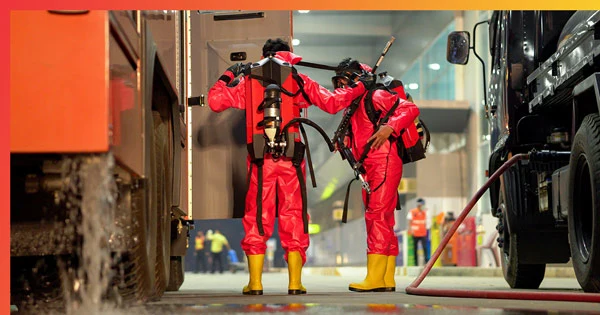
Our SCBA training reviews Personal Protective Equipment, how to properly don it, and proper use of it.  It is four hours in length, and is a hands-on course using the equipment you will need in an emergency response situation at your facility.This course is important for companies that have an emergency response team, or for companies that house chemicals on site that could create a hazardous situation. It teaches employees what to wear when working around each chemical, the hazards of chemical reactivity and health hazards, to name a few.

SCBA is defined as Self-Contained Breathing Apparatus.

SCBA’s are comprised of three main components. The air tanks, the back pack assembly and the regulator. Steel and Aluminum tanks should be hydrostatically tested every five years, composite bottles (which are made up of two or more materials) are 3 years and have a fifteen-year life span. After the fifteen years have passed as of now, they need to be replaced by something newer.

The back pack assembly will need to be inspected monthly as to the straps and fasteners are still working and in good shape.

The regulator will need to be checked for proper operation each month and once a year the regulator must be flow tested to verify it is still supplying atmospheric pressure plus one pound to verify it is operating as a positive pressure regulator.

OSHA does have a great checklist to go buy when one must check the equipment every month. The bottles may also have to be replaced if they do not pass the hydrostat date.

There are two primary types of SCBA’s: open circuit and a closed circuit. What this means is that the open circuit is a supplied airline or hose from a continuous source of outside air and the closed circuit means the wearer has the air bottle on their persons.

The SCBA is considered a positive pressure respirator. This means it gets its air directly from the air tank you will have on. They are alarmed for safety as well. They have bells or whistles on them that will indicate the amount of air you have remaining in the tank you are wearing. The older styles will alarm when there is twenty-five percent of air remaining, and the newer ones will alarm when there is thirty-three percent remaining. The air bottle comes in three different capacities, 2216, 3000 and 4500 PSI or also called thirty, forty-five, and sixty minute bottles.